
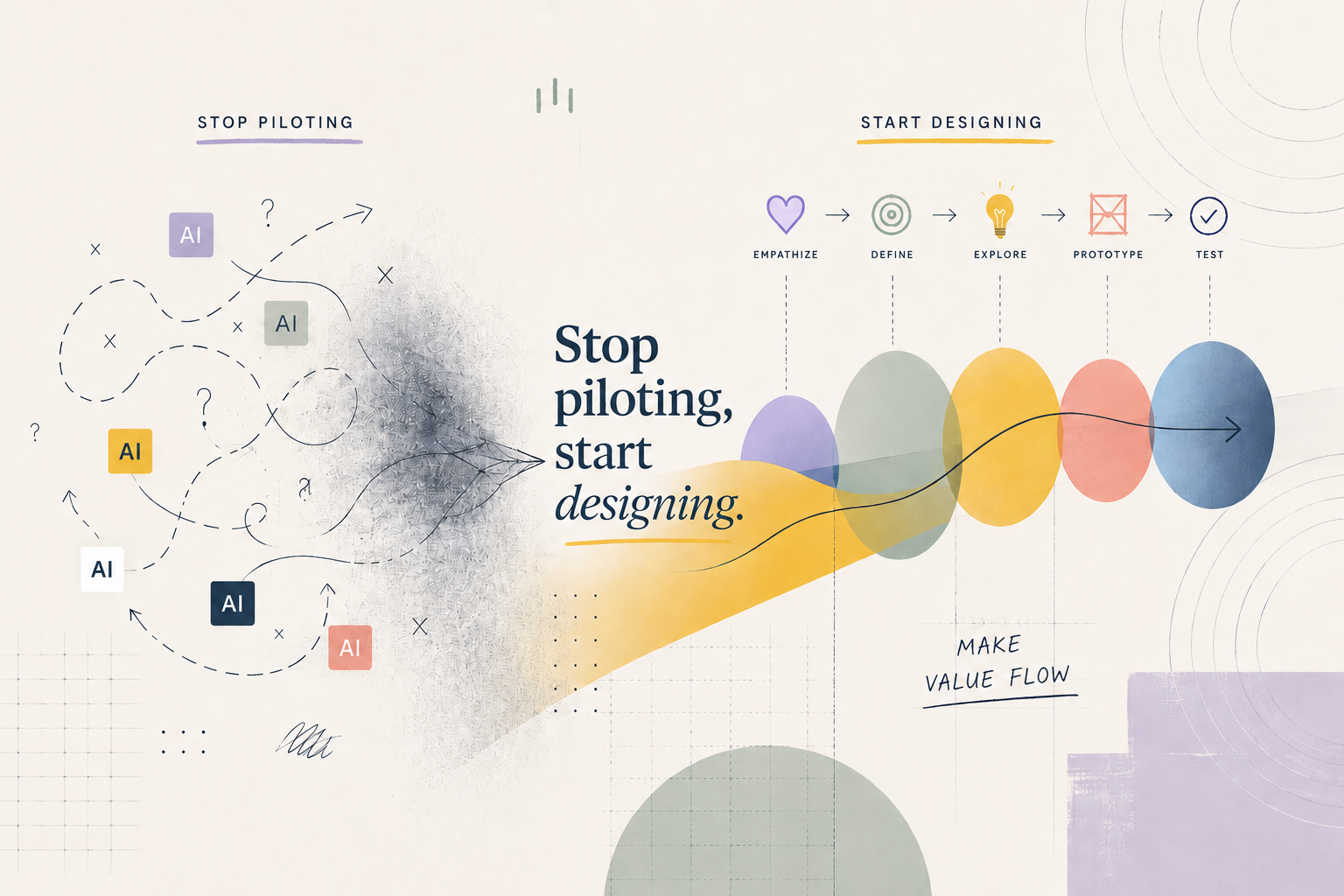
Stop piloting, start designing.
By Greg Evans
I’ve been a process improvement practitioner for a long time. In the work we’ve done over the last five years or so, we’ve achieved some breakthrough improvements by drawing on design thinking, service design and lean disciplines - and being deliberate about which ideas the situation actually calls for. And while the tools and methods matter, the more important shift has been specifically in how we think about process problems.
I can distil it down to this:
The most useful question isn’t “what’s wrong with this process?”, it’s: “how should this work?”
While that might sound like a small reframing, it’s not. And I think it’s more important now that we’re in the age of AI…Here’s why:
Process improvement methods often deliver incremental gains by focusing on fixing what’s there; by addressing existing pain points and root causes. A design-led approach starts somewhere different. Understanding why a process exists, what value it’s supposed to create, and asking “how should this work?”, focuses the effort on solving for the best way to organise the work so that it creates value for customers and meaning for people. More often than not, this kind of approach leads to breakthrough improvements.
I’m not talking here about design as a re-badged version of process re-engineering. Treating the work done by people, that exists to serve people, as an engineering problem is somewhat missing the point. Process re-engineering treats an organisation like a machine - breaking processes into a logical hierarchy, and then optimising the parts. This idea makes sense on the surface - but it tends to produce processes that look right on paper and don't work very well in practice. That's often because people were treated as variables, or inputs, or ‘targets’ rather than as the point of the exercise. Design starts somewhere different. It starts with needs of the people the work is meant to serve and solves for the best way to meet those needs: “how should this work?” - the processes, the technology, the roles are designed to find the best way to address that question.
I know there’s a view that design-led approaches take longer. In my experience, that’s not necessarily true. To give you one example - in partnership with our client, we completely redesigned a university’s casual academic engagement process in just 11 weeks. Together we did the design work, technology development and implemented a new process that complied with new federal legislation and was a lot more efficient with far less manual effort required. In doing so we eliminated a set of long-standing process problems. But here’s the thing - We didn’t focus on solving those problems at all. We focused on why the process existed and how it needed to work.
Of all the disciplines we draw on, it’s worth unpacking Lean a bit more before we get to AI - partly because one of its core ideas helps to explain what I think’s going wrong with AI adoption right now.
Lean is about making value flow. In the context of process design, it starts with being really clear about what actually counts as value, and then redesigning the end-to-end flow of work so that almost every step is either directly creating that value or clearly enabling it. Anything else the process does is treated as a design hypothesis to challenge, simplify, or eliminate. And like service design, Lean doesn't treat the initial design as fixed. Both build-in structured experimentation - testing what's working, learning from what isn't, and closing the gap between what should be happening and what actually is. The idea that you design to maximise the flow of value to the customer is exactly what most AI pilots skip.
What makes the current AI moment distinctive is the speed and scale at which adoption is happening, and the relatively low barriers to getting started. Unlike factory or warehouse automation, which is capital-intensive and demands some rigorous justification before a dollar is spent, AI pilots are relatively cheap and easy to run. That's mostly a good thing. But it also means organisations can move fast without doing the work that more expensive technology would have forced them to do. The pattern that tends to emerge is: pilots proliferate, some work well as point solutions and make a specific task faster or more efficient in isolation, but in aggregate they're not delivering meaningful value. The reason, more often than not, is that AI is being inserted into processes that were never designed to work well in the first place.
Through years of running improvement projects, I’ve seen that automation amplifies what's already there. If the process is not well-designed, automation gives you ‘faster’ waste - errors, rework, inventory; faster misalignment - potentially optimising internal steps that customers don’t care about; and ‘islands’ of efficiency with no net benefit. You can make one part of the process objectively more efficient and get no net benefit, because you haven't designed the upstream and downstream steps to take advantage of it.
AI is one way of organising the work, in the same way robotics has been used in manufacturing and warehousing for decades. But you wouldn’t drop robots randomly onto a production line and expect a better factory. The question that matters isn’t “where can we insert AI agents?” It’s: “what value are we trying to create, and how does work need to flow to create it?” Once you’ve answered that, AI might be a powerful part of the solution. But the thinking - and design thinking in particular - has to lead the technology, not follow it.
So how should this work?
If your AI initiative isn’t producing a measurably better service for your customers, or a measurably lower cost of delivering that service, then something’s wrong. What’s wrong is that you probably started with ‘what can we automate?’ instead of ‘how should this work?
This doesn’t have to mean starting from scratch or overhauling everything at once. It means picking the processes that matter most - the ones where there’s the greatest gap between how things work and how they should - and applying a different kind of thinking to them.
Start with Design × Lean: Why does this process exist? What do our customers actually value? What’s the best way to organise the work to create that value?
Get that right, and AI won’t just be a pilot. It’ll be delivering meaningful value.
